


Innistrad: Midnight Hunt introduces several new mechanics while bringing back some favorites. Let’s look at each of them through a game design lens.
Day/Night & Transform
Though it may seem unremarkable to veteran players, the Flying mechanic is a design home run. New players can often guess what the mechanic does immediately after hearing its name, and it’s easy to understand because it perfectly captures the flavor of the real-world effect.
Transform does something similar. While it is certainly more complex than Flying, and has the downside of requiring sleeves or checklist cards, it is arguably one of the most evocative, flavorful mechanics in the game. Turning a card upside down and getting a different, but often related, card on the back does a fantastic job of capturing the idea of a transformation. Transform consistently scores highly in player surveys, and their frequency has increased since their initial introduction in Innistrad. Because so many natural (or supernatural!) phenomena involve transformation, the design space for this mechanic is enormous.


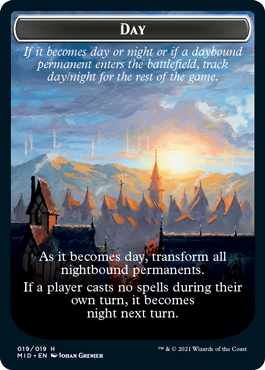
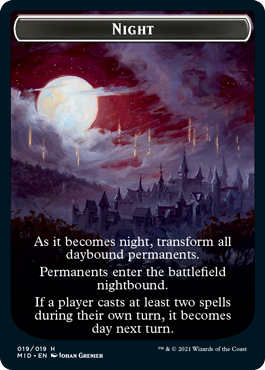
This time around, Wizards did something different with Transforming Werewolves: they introduced a Day/Night indicator that globally triggers the transformation of werewolves, and sets which side they enter the battlefield on.
Let’s start with the positives: flavorfully, the Day/Night token allowing Werewolves to enter the battlefield on the appropriate side is a nice upgrade from the previous iterations of Werewolves. In the past, a Werewolf would enter on its “Day” side into a board full of “Night” side Werewolves, and it would then need to wait for the “Night” condition to be met for a second time before it would transform.


Second, the act of actually flipping the Day/Night token feels different from just flipping the Werewolves (in a positive way). The token also allows other, non-Werewolf/non-Transforming cards to care about the time of day. Taken together, it really feels more like a player is flipping between day and nighttime in the game than it has in previous iterations.
The foremost downside, of course, is that the mechanic is confusing. There’s a paragraph of text on the token explaining how it’s implemented, additional keywords (Daybound and Nightbound) that often show up without explanation, and it subtly differs from the previous Day/Night mechanic in that the time of day can only be affected by the player whose turn it is. This lack of backwards compatibility is troublesome for more casual players, particularly those seeking to enjoy flavor by building a Werewolf deck, where some of their creatures will transform to Daytime but others won’t because the global indicator says it’s still Nighttime.


Overall, Transform is a home run like it is every other time it’s been used. Day/Night is good in Standard/Limited gameplay, but has some weaknesses in casual formats with a larger card pool. I also believe that the exploration of game objects that are not “cards” (Day/Night, Dungeons) has opened up fertile design space for the future. Even just repeating Day/Night in a different context (Lorwyn, for example) would give it a different, but equally flavorful feel.
Flashback
Flashback is another mechanic that is always a home run and is much beloved by players. It’s also one of the best mechanics that Wizards has designed.

Some of the most successful mechanics in the game are those that reward players for doing things they do anyways (Landfall, Battalion, Raid, etc) and those that give players things to do when they’ve run out of actions/cards in the late game (Cycling, Kicker, X-spells). Flashback is one of the very few mechanics that does both. Flashback is unlocked when you cast the front side of a spell that you’re going to cast anyways, and it’s often most useful when you don’t have anything else to do.
Wizards has chosen to balance most of the Flashback cards by costing the front cards pretty normally and making the Flashback cost overcosted. This makes the mechanic pure upside, and helps players to not feel bad casting the front side of the cards to “pay” for the free two-for-one. When WotC tries to push cards with Flashback, they typically lower the Flashback cost to be close to the mana cost or provide a bonus if it’s Flashed back.

Flashback might not seem to be as creative as something like Day/Night, but, much like flying, its simplicity, power, and feel-good/fun nature explains why the mechanic is so elegant and popular.
Disturb


The Disturb mechanic is a natural evolution of combining Flashback and Double-Faced cards. The Aftermath mechanic in Amonkhet was the first mechanic to do this; it allowed spells to have “Flashbacks” that were different from their fronts. Amonkhet also expanded Flashback to creatures with Embalm and Eternalize. Disturb allows players to cast creatures for a second time and get something different.
Disturb shares most of the same upsides as Flashback. It gives players something to do later in the game, is free card advantage, and rewards players for trading their creatures in combat, something they do anyways.
However, there are several reasons I’m not as high on Disturb as I am on Flashback, and they all have to do with the constraints introduced by Innistrad. In a vacuum, a mechanic that allows you to cast a different creature from a graveyard than the one you cast initially has lots of cool space to play with, much like Aftermath. But in practice, Innistrad introduces limits on this:
1) The front side must be Human (except for Galedrifter for some reason).
2) The backside must be a Spirit with Flying.
Why is this a problem? First off, Humans tend to be small. Other than Humans that grow in accordance with the number of creatures you control/enter the battlefield/etc, they tend to be 2 or less power and toughness. Additionally, their mana cost is typically constrained to 3 or less. Naturally, this limits the design space of a card with Disturb.
The back side goes further. Flying is a powerful mechanic. With a meaningful number of Disturb creatures in the set at common/uncommon, this places constraints both on the cards themselves and on the rest of the format. If one of the named mechanics revolves around Flying, the format needs to be built to accommodate that, and the cards need to be built to accommodate the format. Because the cards are both fliers and card advantage, they tend to be on the smaller/weaker side. None of this is necessarily bad in terms of gameplay, but it does restrict the kinds of cards that we can see in the set.
Additionally, an important element of successful media is delivering on audience expectations. Innistrad, through the first two blocks, has established that we can expect five tribes when we visit: Humans (GW), Vampires (RB), Werewolves (RG), Zombies (UB), and Spirits (UW). Disturb did two things that likely disappointed some players: it muddied the Human tribe’s identity and it failed to deliver for fans of Spirits.


Because many Werewolves are Humans on their front side, much of the Human allotment needs to go toward that. In past Innistrad sets, this is actually nice; there’s some overlap in Green between the two tribes, which leads to good gameplay, but this overlap isn’t at the expense of Humans. This time, that overlap is further strained by requiring overlap in White with Spirits. Pushing into Blue to further ensure that the Spirits tribe was filled out meant that the Humans didn’t feel as cohesive as a tribe as they have in the past.


Spirits suffered as well. In previous Innistrad sets, Spirits have been Flying, tempo-oriented, with Flash, tapping, and other trickiness. In Innistrad, Spirits are almost entirely relegated to being flashed back from the graveyard via Disturb. If this were our first visit to Innistrad, and no promises had been made, I think this execution on Humans/Spirits would be fantastic. Yet Disturb makes Spirits into a byproduct of humans. Like Day/Night, Disturb doesn’t do a great job of being backward-compatible with the previous Spirits. A casual player who wants to throw together a Spirits deck would likely be disappointed having to play a bunch of Humans that don’t have any synergy with the rest of the tribe until after they’re dead.
To summarize: using Disturb to implement the Human/Spirit creature types is flavorful and cool, but because it fails to deliver on the expectations we had going into Innistrad regarding Humans and Spirits, it feels worse than it would have in a non-Innistrad expansion.
Later this week, I’ll wrap up reviewing the Midnight Hunt mechanics with Investigate, Coven, Decayed, and the unnamed Vampire mechanic!
Ryan Normandin is a grinder from Boston who has lost at the Pro Tour, in GP & SCG Top 8's, and to 7-year-olds at FNM. Despite being described as "not funny" by his best friend and "the worst Magic player ever" by Twitch chat, he cheerfully decided to blend his lack of talents together to write funny articles about Magic.


